
How to Buy Texas Redfish
A wholesale buyer's guide — species, regulation, grading, cold chain, menu language, and the questions to ask any supplier before the first order.
If you are sourcing redfish for a restaurant, a distribution warehouse, a fish counter, a broker program, or a hotel F&B operation, this is the page we wish you had on screen before the first call. Everything here is either a fact with a public source, a sourcing norm we have seen hold across buyer types, or an operational specific we confirm per order. Payment terms are set per customer and are not a topic for the public web — every other question about buying Texas redfish is answered below.
Contents
What's in this guide.
- What Texas redfish is
- Why every U.S. commercial redfish is farmed
- Taste, texture, and how redfish cooks
- Product forms and cuts you can order
- Sizes, grades, and fillet yields
- Fresh vs. frozen vs. IQF — the economics
- What to expect by buyer type
- How the cold chain and lot ID work
- Sustainability: what's real, what to demand
- Ten questions to ask any redfish supplier
- Ordering from Turtle Creek
01
What Texas redfish is.
Redfish is Sciaenops ocellatus, a member of the Sciaenidae (drums and croakers) family, native to the Western Atlantic and the Gulf of Mexico. Texas coastal waters sit at the heart of its historic range. The fish is coppery-bronze with a distinctive black spot near the tail (the ocellus, which gives the species its Latin name); sometimes the spot is doubled or tripled. Per Texas Parks & Wildlife, redfish is the second-most-popular saltwater sport fish in the state, and it was designated the official Texas State Saltwater Fish.
"Redfish" and "red drum" are the same species. Texas common usage favors "redfish." Federal and scientific literature tends to prefer "red drum." Other regional common names include channel bass and spot-tail bass. Your menu, counter signage, and procurement documents can use "redfish" without risk of confusion; if a compliance reviewer wants the formal Latin, "Sciaenops ocellatus" is what they are looking for.
02
Why every U.S. commercial redfish is farmed.
In March 1980, Chef Paul Prudhomme served blackened redfish at K-Paul's in New Orleans. Within a few years the dish was so popular that Gulf wild catches climbed from roughly 2.7 million pounds in 1980 to 8.3 million pounds by 1986. In 1981, Texas designated redfish a state game fish, removing it from the commercial wild market in Texas. In 1987, the U.S. Department of Commerce closed federal Gulf waters to commercial redfish fishing.
Today, commercial harvest of wild redfish is illegal in Texas, Louisiana, Alabama, Florida, and federal Gulf waters. Mississippi is the only state where commercial wild-redfish fishing remains legal, and its commercial volumes are nowhere near what U.S. restaurant and retail demand requires. In practice, every fresh commercial redfish on a U.S. dock is farmed.
That is the first fact every redfish buyer needs. The second is that per the USDA 2023 Census of Aquaculture, 8 of 9 commercial U.S. redfish farms are in Texas. As Todd Sink of Texas A&M AgriLife Extension put it: "If you buy farm-raised red drum at a supermarket or order it at a restaurant anywhere in the U.S., there's a very good chance that it was produced in Texas." The question, therefore, is which Texas farm — and whether that farm can answer the questions in this guide end to end.
03
Taste, texture, and how redfish cooks.
Redfish flesh is firm, mild, and white, with moderate fat. It holds its shape through high-heat cooking and does not fall apart in a sauté pan the way some white fish will. That mechanical toughness is why the blackened preparation works — the pepper-spice crust takes high cast-iron heat without destroying the fillet underneath.
The classic high-heat preparations are blackening (Prudhomme's 1980 recipe, still the reference), pan-searing with skin on, and grilling. The other classic is "on the half shell," where the fillet is cooked skin-on and scales-down on a grill or in an oven; the scales act as a heat shield and the skin releases cleanly at the table. NOAA Fisheries references this preparation in its profile of our farm.
Redfish also cures well for ceviche and crudo, roasts whole cleanly (the 2–4 lb food-size range is a workable whole-roast size), and holds up to curing for gravlax-style applications. It is not an oily fish — do not expect salmon-like richness on the plate. It is a balanced, versatile canvas for a seasoning or a sauce.
04
Product forms and cuts you can order.
The main product forms, from most raw to most prepared:
- Whole, head-on. As the fish comes out of the water, gills in. The shortest chain-of-custody claim, and the most versatile raw material for a kitchen. Whole-fish display also works at a fish counter with a knowledgeable counter team.
- Head-on gutted (HOG). Whole fish with viscera removed. Common retail-counter form for customers who want to portion at home.
- H&G (headed and gutted). Gutted with head removed. Common distributor and wholesale form when the downstream customer does their own filleting.
- Skin-on fillet. Two fillets per fish, skin retained, pinbones in or out by spec. The most common restaurant form. Supports the half-shell preparation.
- Skin-off fillet. Skin removed. Cleaner presentation for fine-dining portions and ceviche.
- Portion-cut / butterflied. Fillets cut to an exact portion weight and shape. More processing, less kitchen flexibility — useful for banquet volume where every plate must match.
- Collars and frames. Byproduct of filleting, under-used domestically but valued in some Asian and Latin traditions. Ask; they are often available at very low cost if your kitchen has a use.
A typical restaurant order is skin-on fillet, hand-graded to a target portion weight. A typical distributor order is H&G or a mix, by the pallet. A typical retailer order is a mixed case of whole HOG and skin-on fillets for counter display. The buyer-specific pages cover the details by engagement type.
05
Sizes, grades, and fillet yields.
Food-size redfish harvest weights commonly run 2 to 4 pounds whole. Larger and smaller sizes can be planned in advance from grow-out cohorts; specific count-and-weight grades are confirmed at order and printed on the lot card that travels with the shipment.
The practical costing question for a chef is: "how many portions does a 3-pound whole fish make?" The honest answer is that fillet yield depends on cut, trim, and yield spec — and yield percentages we have seen quoted in the industry vary enough that we prefer to confirm yield by product form with operations at order time rather than publish a number we cannot hold. As a framing, a 3-pound whole fish yields substantially less than 3 pounds of plated fillet; plan on two skin-on pan-size fillets per whole fish at typical food-size weights. Exact yield, for your exact cut spec, lives on the lot card.
Two notes for kitchen planning:
- Grade consistency matters more than peak yield. A 6-ounce portion costed into your menu this week is worthless if next week's fish comes in smaller. Ask the supplier how grade is held across a standing order.
- Hand-grading at harvest is different from grading after storage. Hand-grading at harvest means the fish are sorted as they come out of the water, before ice and transit. That matters for yield consistency at the receiving kitchen.
06
Fresh vs. frozen vs. IQF — the economics.
Three ways redfish moves through the U.S. market:
- Fresh, direct from farm. Harvested, iced, packed, shipped cold-chain, received within days. Best quality, shortest shelf life, highest price. The form Turtle Creek ships.
- Frozen whole or filleted. Frozen after processing, often at origin. Longer shelf life, more logistical flexibility, lower price per pound than fresh. Quality depends heavily on the freeze method and the thaw discipline at the receiving kitchen.
- IQF (individually quick frozen) fillets or portions. Frozen as separate portions at very low temperature very fast. Useful for retail freezer programs and large-scale food-service operations that want portion control and long shelf life. Inherent yield loss on the freeze-thaw cycle.
The honest framing: fresh beats frozen on quality when the cold chain is handled and the volume fits your turnover. Frozen and IQF exist because not every kitchen or counter has the volume or the receiving discipline for standing fresh deliveries. If a supplier only offers frozen, that does not mean the product is bad — it means the logistics model is different from ours. We do not sell IQF.
The question to ask: "how many hours elapse between harvest and shipment, and what's the cold-chain log look like at receiving?" The answer tells you whether "fresh" is accurate or a marketing word.
07
What to expect by buyer type.
The universal redfish story is above. What changes meaningfully by buyer type is order size, delivery cadence, lot-ID flow, and labeling norms. Each of the five buyer-specific pages has the full spec; short version below.
Restaurants & chef-owners
Case-sized, menu-ready, chef-direct.
A first order is typically a single case of skin-on fillet, hand-graded to your portion spec. Standing weekly cadence once the menu pattern is clear. Texas-grown label is defensible for fish shipped direct from our farm. Full spec for restaurants →
Seafood distributors
Pallet-scale, year-round, lot-tagged.
A first order is typically a pallet, H&G or mixed, on a cold-chain freight lane. Standing weekly or twice-weekly cadence planned against our harvest calendar. Wholesale fish moves downstream unlabeled per industry convention. Full spec for distributors →
Retailers & grocery
Case-ready, signage-ready, FIFO-clean.
Mixed case of whole HOG and skin-on fillets, graded for counter display. Harvest-date-based rotation. Category-level Seafood Watch reference is citable with a link to the source report. Full spec for retailers →
Brokers & fish program managers
Multi-drop, per-account tagged, broker-first.
Multi-destination delivery on a single harvest day. Per-account carton tagging. Consolidated invoice with per-account poundage and lot IDs summarized. Explicit no-end-run pledge. Full spec for brokers →
Hotels, resorts & country clubs
Banquet-scale, multi-property, named-farm story.
Standing weekly orders, multi-property corporate P.O.s with per-property drops. Texas-origin story fits Texas-destination venues. Known-date banquets planned against grow-out cohorts. Full spec for hotel groups →
Not sure which fits?
Call and we'll tell you.
Hybrid accounts happen — a hotel that also runs a standalone restaurant, a distributor that also works with a broker program, a retailer adding a cafe. A five-minute call sorts the right engagement shape. 713-364-3701.
08
How the cold chain and lot ID work.
Cold chain is the sequence of temperature-controlled steps between harvest and receiving. For fresh redfish, a competent cold chain looks like this: fish iced at harvest; packed in insulated containers with gel or wet ice matched to transit time; moved on refrigerated trucks on direct routes or refrigerated-freight carriers on longer lanes; temperature logged at pack and (for long routes) at checkpoints; received cold and moved into the kitchen or counter cold box without delay.
What to demand from any supplier:
- A temperature log on request. Not a promise — an actual record.
- Pack specs that match transit time. Gel ice for short routes, wet ice plus insulation for longer routes, refrigerated-freight for the longest.
- A named carrier or a documented in-house route. "We'll figure it out" is not an answer at scale.
- A receiving-side check. The supplier should ask about your dock temperature and your receiving cadence.
Lot ID is the paper trail. Every shipping carton carries a lot ID that traces back to broodstock genetics, hatchery date, raceway number, harvest date, processor, and recipient. The lot card travels in the carton. Useful for three things:
- Provenance on a menu or counter. When a customer asks "where did this come from," the lot card is the answer.
- FIFO rotation at retail. Counter teams rotate on harvest date, not receive date.
- Recall discipline. If anything goes wrong — yours or the industry's — the lot traces back to a specific day, a specific raceway, a specific broodstock cohort. That's what a food-safety auditor wants to see.
A public per-lot URL pattern (turtlecreek.fish/lot/[id]) is in development for v1.1. Until then, the lot card travels in the box and the trace is pullable by sales contact.
09
Sustainability claims — what's real, what to demand, what's legally safe to say.
Three honest facts about sustainability claims in the redfish category:
First, the Monterey Bay Aquarium's Seafood Watch program rates U.S. pond-farmed redfish as Best Choice. That rating applies to the production category, not to any single farm. Citing it on a menu or counter is fine; claiming a per-farm Seafood Watch rating is not. Link to the source report and frame it as a category rating.
Second, BAP and ASC are per-farm certifications that some aquaculture operations hold. If a farm claims "BAP certified," ask for the certificate number and expiration; they are public records. Turtle Creek does not hold BAP or ASC today; we do not claim certifications we do not have.
Third, "sustainable" as an unqualified adjective has become an FTC attention point. The safer posture for any buyer citing sustainability is to state specific, measurable practices — "constructed wetland for discharge polishing," "recirculating system reducing make-up water demand," "native species farmed in its regional watershed" — rather than the word "sustainable" without a measurable claim attached.
What to ask any supplier: what do you publish, and what can I cite? A farm that publishes water-reuse rate, feed conversion ratio, biosecurity SOP, and discharge treatment can be cited on a menu or counter defensibly. A farm that only has a hang-tag with the word "sustainable" cannot. Our published practices →
10
Ten questions to ask any redfish supplier.
Print this page. Ask every question on the first call. Any supplier worth a standing relationship should answer all ten without stalling.
1. What species do you raise?
One species: Redfish (Sciaenops ocellatus), native to the Western Atlantic and Gulf of Mexico. Ask any supplier whether they raise a regional native or an exotic; the answer tells you a lot about their conservation posture.
2. Where is your farm?
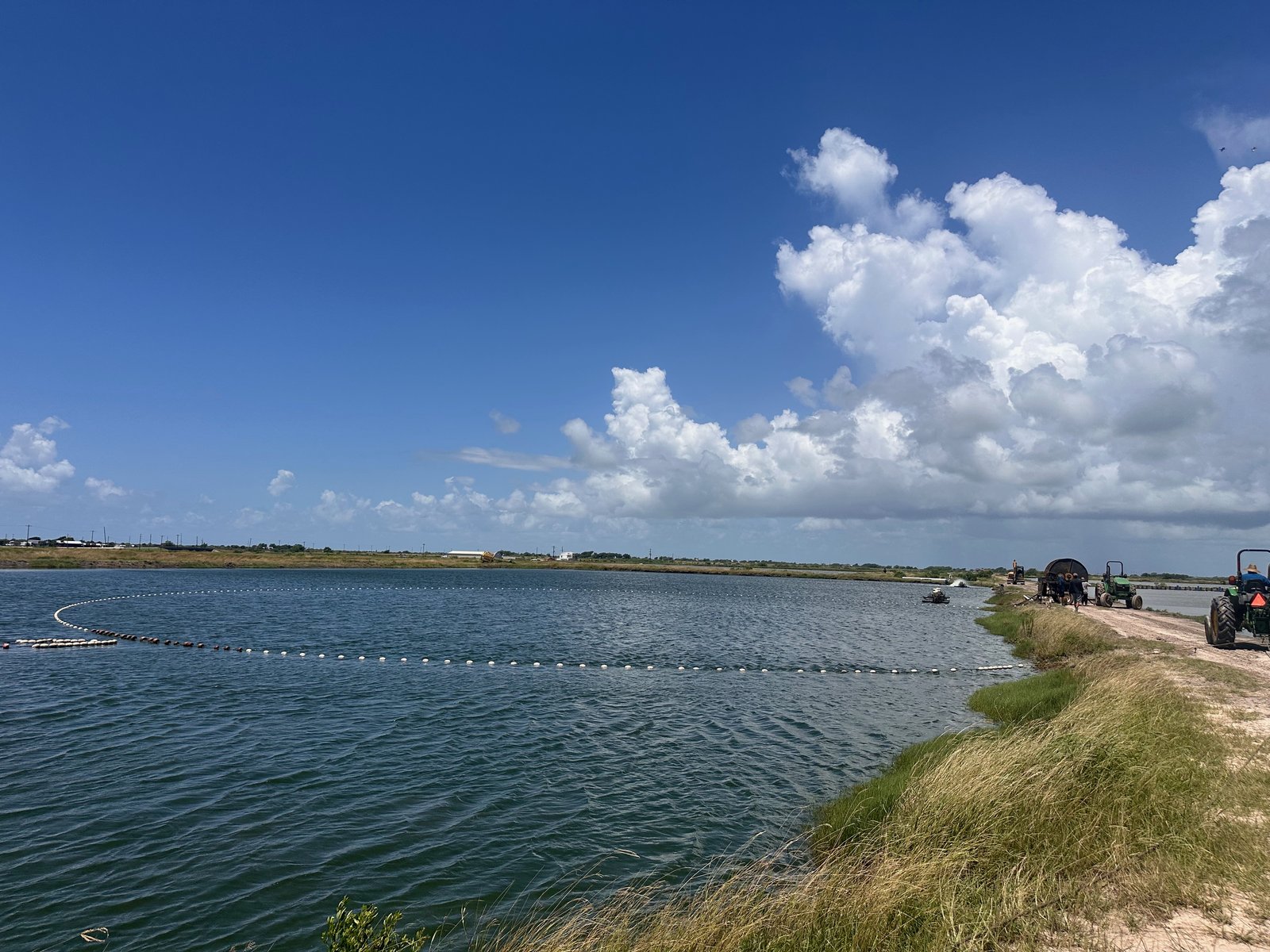
7474 TX-35 S, Palacios, TX 77465, on Matagorda Bay. Per the USDA 2023 Census of Aquaculture, 8 of 9 U.S. redfish farms are in Texas; "Texas farm" is a checkable fact, not a marketing claim.
3. Fresh or frozen, and how many hours from harvest to shipment?
Fresh, not frozen. We harvest twice a week and pack direct from harvest; most orders are in transit within hours, on a refrigerated carrier or iced for same-day delivery. "Fresh" is a verifiable claim backed by the harvest calendar — not a marketing adjective.
4. What's on the lot ID, and how far back does it trace?
Every shipping carton carries a lot ID that traces back to broodstock genetics, hatchery date, raceway, harvest date, processor, and recipient. The lot card travels in the box. A public per-lot URL pattern is in development for v1.1.
5. What's your biosecurity SOP?
Quarantine, gear sanitation, vehicle decontamination, and a pathogen-monitoring schedule. Reviewed annually, available for partner due-diligence. A supplier that cannot hand you a biosecurity SOP is a supplier you do not want when a disease event hits the industry.
6. Do you publish water-use, feed-conversion, or discharge data?
Recirculating water-reuse rate and feed conversion ratio will publish annually in the transparency report (first full report scheduled Q4 2026). Constructed saltmarsh wetland for final discharge polishing. Per-raceway water-quality logs available to partner agencies on request.
7. What's your grading and yield spec?
Whole fish and filleted product, hand-graded at harvest to a published spec. Food-size harvest weights commonly run 2–4 pounds whole. Specific count-and-weight grades and fillet yields are confirmed at order and printed on the lot card.
8. What's the cold-chain handoff, and can I see a temperature log?
Insulated packaging, gel or wet ice matched to transit time, refrigerated trucks on direct routes. Temperature logs are kept and available on request — standard recordkeeping, not a favor. Ask for the log; if the supplier hedges, that is the answer.
9. What third-party ratings or certifications apply to your fish?
The Monterey Bay Aquarium's Seafood Watch program rates U.S. pond-farmed redfish as Best Choice — a category-level rating, not a per-farm rating. We do not claim a per-farm certification; we cite the category rating and link to the source report. If a supplier claims a per-farm Seafood Watch rating, ask for the URL.
10. What can I legally say on my menu, counter, or collateral?
Defensible: "farm-raised," "Texas-grown" (for fish we ship direct from the farm), "from Palacios, Texas," "Sciaenops ocellatus," "Texas State Saltwater Fish." Avoid unqualified "sustainable" without a measurable claim attached. We will send you the full public reference set on request. Confirm final wording with your counsel.
11
Ordering from Turtle Creek.
If this guide has answered the questions you needed answered, here is the fastest path to a first delivery.
No web form in v1. The fastest path is a phone call to 713-364-3701. If you would rather email, send to Sales@turtlecreek.fish with your business name, buyer type (restaurant / distributor / retailer / broker / hotel), delivery zip, expected weekly poundage, and whole vs. filleted preference. Most first inquiries get a same-day or next-business-day quote.
Call (713) 364-3701
Email Sales@turtlecreek.fish
Hours Daily, 9:00 AM – 5:00 PM Central
Visit 7474 TX-35 S, Palacios, TX 77465 — by appointment
← For Buyers hub · The species · Wild vs. farmed · Sustainability practices