Sustainability
Evidence over anecdote.
Claims about quality, sustainability, and outcomes have to be measurable and documented. If we can't prove it with data, we don't say it.
The fish is our product. The water and the wild fishery are our responsibility. Below, four areas where we have something to point to — and a clear note on the metrics we have not yet published.
01 · Constructed wetlands
Water that comes in clean, water that leaves cleaner.
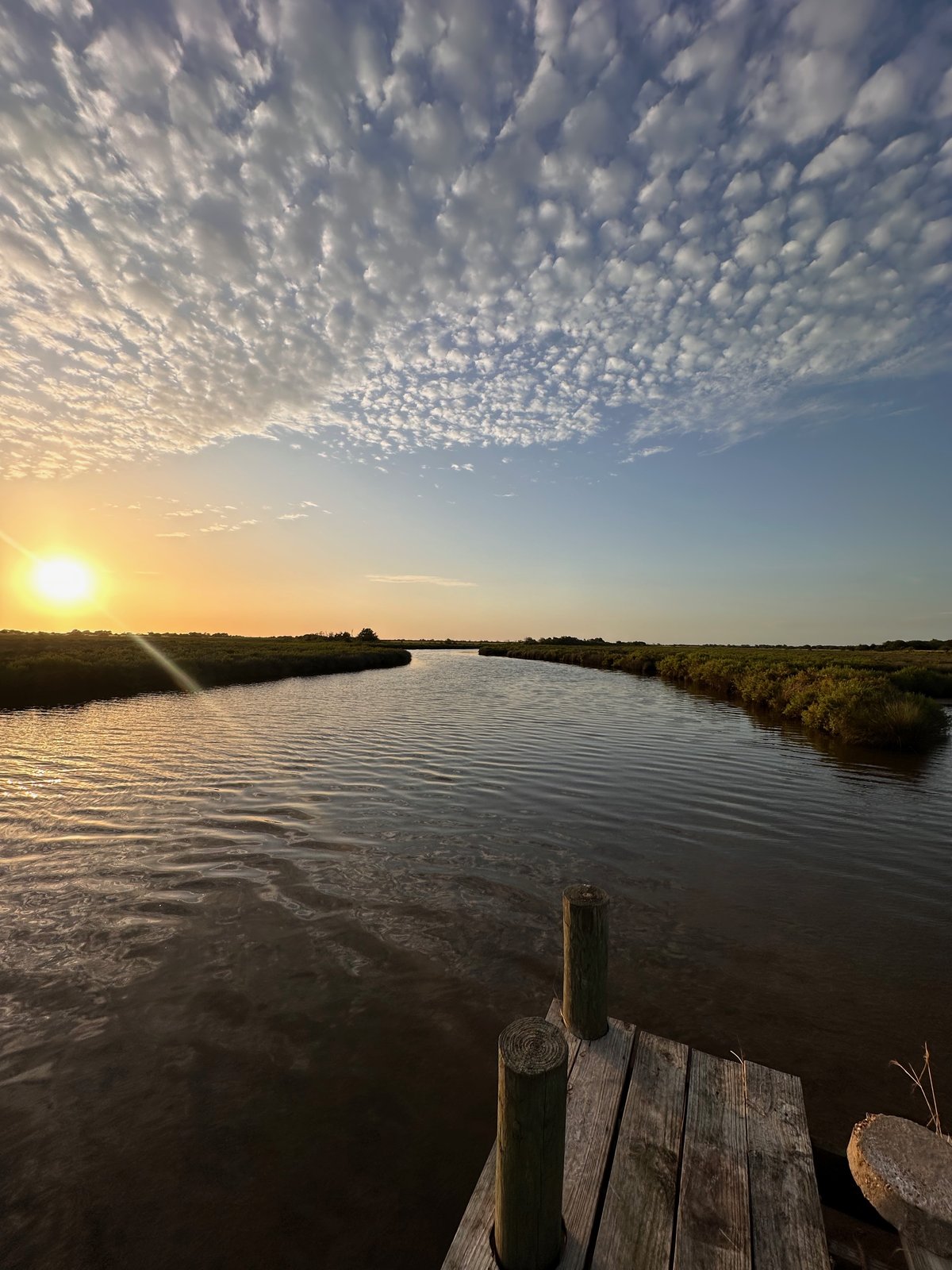
Roughly 10 to 15 percent of our 126 acres is reserved for marine wetlands. The wetlands do two jobs: they treat farm water before it returns to the bay, and they grow plants we can use to seed constructed wetlands elsewhere along the coast.
This is operations, not landscaping. The wetlands are why our farm water can be discharged in the first place.
We are partners with the Matagorda Bay Foundation on a saltmarsh-restoration nursery — growing the plants that go into new wetlands along the Texas coast.
"On our farm, we have built and are building wetlands to treat our water as well as to grow plants for constructed wetlands in other areas. We strive to enhance the natural environment around us, our ecosystem, as we are so dependent upon it. And of course, wetland marshes are the most efficient ecosystems at sequestering carbon."
— Nasir Kureshy, in NOAA Fisheries
02 · The category rating
U.S. pond-farmed redfish is rated Best Choice by Seafood Watch.
In 2023 Monterey Bay Aquarium's Seafood Watch program assessed U.S. pond-farmed redfish and rated it Best Choice — the program's top recommendation — with a final score of 6.68 out of 10 and no Red-ranked criteria. Standout strengths: data quality (8.4) and effluent (9.0).
Best Choice
Final ranking — U.S. pond-farmed redfish (2023)
Seafood Watch · Aquaculture Standard v3.1
9.0 / 10
Effluent score (settling basins + artificial wetlands)
Seafood Watch report
8.4 / 10
Data quality and availability
Seafood Watch report
The rating applies to U.S. pond-farmed redfish as a category, not to any one farm. We link to the report rather than paraphrasing it.
The report's main caveat: feed scores 4.99/10, reflecting reliance on Gulf menhaden inputs. We name that caveat here because we name caveats.
03 · Industry context
What changed after the 2021 freeze.
In February 2021 a multi-day deep freeze drove many Matagorda Bay producers out of business. Redfish is vulnerable below 40 °F. The lessons from that week reshaped how Texas farms engineer for cold weather.
Engineering around the cold
Outdoor pond cultures use deep thermal-refuge zones (up to 8 ft) and well water pumped to moderate pond temperature in extreme weather. The 2023 USDA Census of Aquaculture, summarized in the AgMRC commodity profile, shows industry contraction post-freeze — and a renewed focus on cold-tolerance breeding.
Texas A&M AgriLife Extension launched the first U.S. redfish genetic-improvement program in 2024, funded by a $300,000 USDA Southern Regional Aquaculture Center grant. Target traits: growth rate, feed conversion, cold tolerance. The improved broodstock is not yet in production at any U.S. farm; we mention it for context, not as a current TCA product attribute.
The dual-pond pattern
Per Texas Sea Grant: "Matagorda County hosts several prominent redfish farms, including Gulf States Aquaculture, Homegrown Seafood, and Turtle Creek Aquaculture." The same feature notes that Matagorda County farms "have pioneered a dual-pond system that improves efficiency and reduces environmental impact."
That sentence is Texas Sea Grant's, not ours; we link rather than re-frame.
04 · The metrics
What we publish — and what we have not yet.
Our brand commits to publishing measurable practices annually. Some figures are in production. Until they're verified and signed off, the slot is empty rather than filled with an estimate.
- Recirculating water reuse rate
- Pending — first publication in our Q4 2026 transparency report.
- Feed conversion ratio
- Pending — first publication in our Q4 2026 transparency report.
- Discharge polishing
- Constructed wetland on the property; treated water before it returns to the bay (qualitative description; quantitative TCEQ-monitored data in the transparency report).
- BAP certification
- Not currently certified. We will list active level and expiration here when achieved. Per brand policy, lapsed certifications are removed from marketing within 30 days.
- ASC certification
- Not currently certified. Same policy.
- TPWD aquaculture permit
- Permit number to publish here once filed.
- TCEQ discharge permit
- Permit number to publish here.
Compliance posture
Marketing matches the filing.
Three sentences govern everything we publish:
- Marketing must match the filing. If the website says it, the file at the agency must support it.
- No claim without a record. Every measurable claim has a document behind it.
- Default to disclosure. When in doubt, say more, not less.
We do not say "all-natural," "organic," "wild-caught," "carbon neutral," "eco-friendly," or "green." Those words are either undefined for our category, regulated by FDA in ways we have not opted into, or required to be backed by third-party verification we do not currently hold.
Have a sustainability question for our menu defensibility?
If you are a chef or a buyer who needs to defend a redfish line on a printed menu, call us. We will send you the public Seafood Watch report and answer specific questions about our practice inside one business day.